Best Aquarium Filter for Large Tanks (2026): Top Reviews & Buying Guide

Finding the best aquarium filter for a large tank isn’t just about choosing the highest flow rate or the biggest canister. Large aquariums hold more water, but they also generate more waste, require greater biological filtration, and demand equipment that can operate reliably around the clock. The right filter helps maintain crystal-clear water, supports a stable nitrogen cycle, and creates a healthier environment for fish while reducing long-term maintenance.
We’ve compared the best aquarium filters for large tanks in 2026, evaluating each model for filtration performance, media capacity, ease of maintenance, energy efficiency, noise level, and overall value. Whether you’re caring for a heavily stocked freshwater aquarium, a planted display, a goldfish setup, or a large cichlid tank, you’ll find recommendations to help you choose a filtration system that matches your aquarium’s size and bioload.
Key Factors to Consider When Choosing a Large Aquarium Filter
Tank Volume and Flow Rate (GPH)
A filter should circulate enough water to maintain stable water quality throughout the aquarium. A common guideline is to choose a filter that turns over the entire tank volume at least 4 to 5 times per hour. For example, a 100-gallon aquarium typically benefits from a filter rated for approximately 400 to 500 GPH under normal stocking levels.
Keep in mind that manufacturer flow ratings are measured under ideal conditions. Actual flow often decreases after filter media is installed and as debris accumulates over time. Selecting a filter with some extra capacity helps maintain adequate circulation between maintenance sessions, especially in larger aquariums.
Bioload and Stocking Density
Tank size alone should not determine filter selection. The amount of waste your fish produce—known as the bioload—is equally important.
A lightly stocked planted community aquarium with small schooling fish generally places relatively little demand on filtration. In contrast, tanks housing large cichlids, goldfish, oscars, plecos, or other heavy waste producers require substantially greater biological filtration and mechanical debris removal.
For heavily stocked aquariums, choosing a larger filter or running two filters often provides more stable water quality, improved circulation, and greater redundancy if one unit requires maintenance.
Media Capacity (The Three Stages)
Media capacity is often more important than pump size alone. Larger filters can hold more filtration media, allowing them to process waste more effectively while extending maintenance intervals.
A well-designed filter should accommodate all three stages of filtration:
- Mechanical filtration removes suspended debris before it breaks down.
- Biological filtration provides surface area for beneficial nitrifying bacteria that convert toxic ammonia into nitrite and then nitrate.
- Chemical filtration uses media such as activated carbon or specialized resins when needed to remove specific dissolved compounds.
Biological media generally provides the greatest long-term benefit in established aquariums, while chemical media is optional for many freshwater setups and can be added when a specific purpose exists.
Energy Efficiency and Noise Levels
Large aquarium filters operate continuously, making power consumption an important long-term consideration. More energy-efficient motors can reduce electricity costs over years of operation without sacrificing filtration performance.
Noise is another factor, particularly in living rooms, bedrooms, or offices. Well-built canister filters are often among the quietest options because the pump is enclosed, while some hang-on-back and internal filters may produce more noticeable water or motor noise. Proper installation, regular cleaning, and removing trapped air can also help minimize operating noise.
Ease of Maintenance and Priming
Routine maintenance is essential for keeping any filter performing efficiently. Filters designed for easy servicing encourage more consistent maintenance and reduce downtime.
Useful features include:
- Quick-disconnect valves that isolate hoses during cleaning.
- Self-priming pumps that simplify startup after maintenance or power outages.
- Large media baskets that can be removed individually.
- Clog-resistant intake strainers that maintain flow longer between cleanings.
- Secure seals and durable locking mechanisms that help prevent leaks.
A filter that is easy to disassemble, clean, and restart is more likely to receive regular maintenance, supporting stable water quality and healthier fish over the long term.
Best Aquarium Filters for Large Tanks in 2026
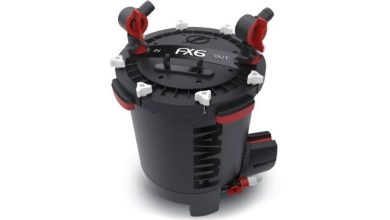
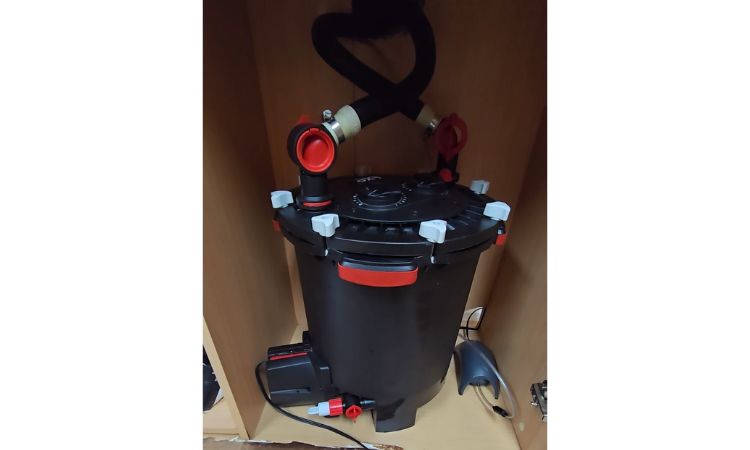
1. Fluval FX6 Canister Filter (Best Overall)
The Fluval FX6 remains one of the strongest choices for large freshwater and saltwater aquariums thanks to its combination of high media capacity, reliable circulation, and straightforward maintenance. Rated for aquariums up to 400 gallons, it is well suited for heavily stocked community tanks, large cichlid aquariums, goldfish setups, and predator fish systems.
Its multi-stage filtration combines mechanical, biological, and chemical media inside large removable baskets, allowing hobbyists to customize the media configuration to suit different aquarium needs. The generous media volume supports a substantial population of beneficial nitrifying bacteria, which is particularly valuable in tanks with high bioloads.
Maintenance is simplified by the FX6’s self-priming system and built-in drain valve, while its Smart Pump technology automatically removes trapped air during operation. Although larger and more expensive than many alternatives, the long service life and strong filtration performance make it a practical investment for serious fish keepers.
Pros
- Suitable for aquariums up to 400 gallons
- Large customizable media capacity
- Excellent biological filtration
- Self-priming operation
- Quiet for its size
- Easy-access media baskets
Cons
- Premium purchase price
- Large footprint requires cabinet space
- Flow may be excessive for delicate species unless dispersed
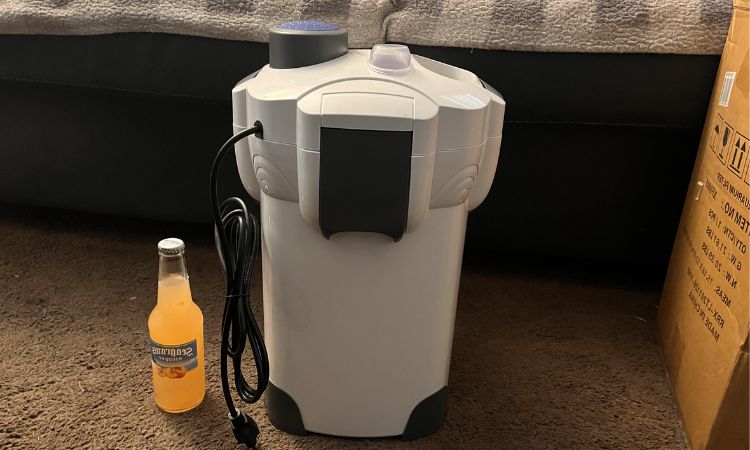
2. Polar Aurora 4-Stage External Canister Filter (Best Budget Canister)
For hobbyists looking for high-capacity filtration without the premium price of flagship brands, the Polar Aurora 4-Stage External Canister Filter offers impressive value. Available in several sizes for aquariums up to 200 gallons, it combines a strong pump with four media trays that can be arranged for mechanical, biological, and chemical filtration.
One feature that distinguishes this model is its integrated 9-watt UV sterilizer, which may help reduce free-floating algae and improve water clarity when used appropriately. The self-priming design also simplifies setup compared to older canister filters that require manual siphoning.
While the included media is fairly basic, the spacious baskets allow easy upgrades with higher-quality sponge, ceramic media, or specialty filtration materials.
Pros
- Excellent value for large aquariums
- Four customizable media baskets
- Integrated UV sterilizer
- Strong water circulation
- Self-priming design
Cons
- Replacement media quality varies
- Larger physical size
- Hose fittings require careful installation
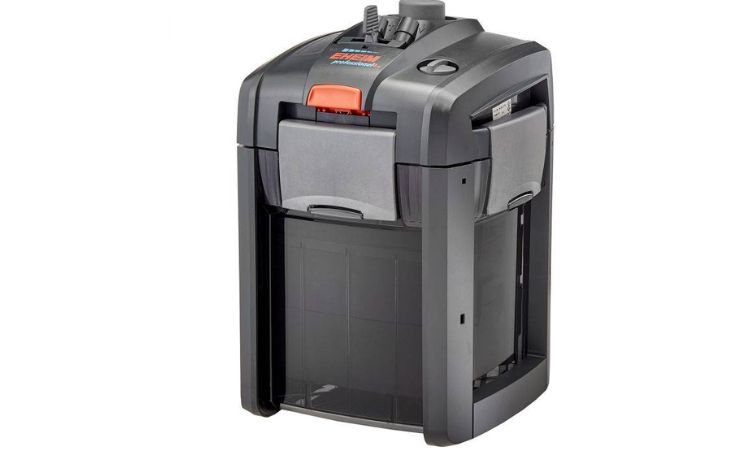
3. Eheim Pro 4+ 250 (Best Premium Mid-Size Filter)
The Eheim Pro 4+ 250 is designed for aquariums around 65 gallons, making it an excellent option for moderately large planted tanks or community aquariums where reliability and quiet operation are priorities.
One of its standout features is the Xtender function, which helps maintain water flow if the mechanical media begins to clog before routine maintenance. The filter also provides multiple media baskets for customizable filtration and is known for its efficient energy consumption.
Although it has lower flow than larger canister filters, its engineering quality and durable construction have earned Eheim a strong reputation among experienced aquarists.
Pros
- Extremely quiet operation
- High-quality German engineering
- Efficient energy use
- Flexible media configuration
- Xtender function helps maintain circulation
Cons
- Higher cost than similarly sized competitors
- Better suited to medium-large tanks than very large aquariums
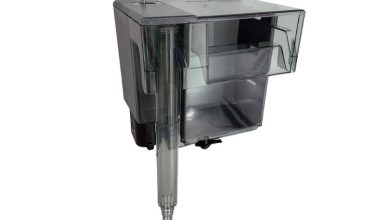
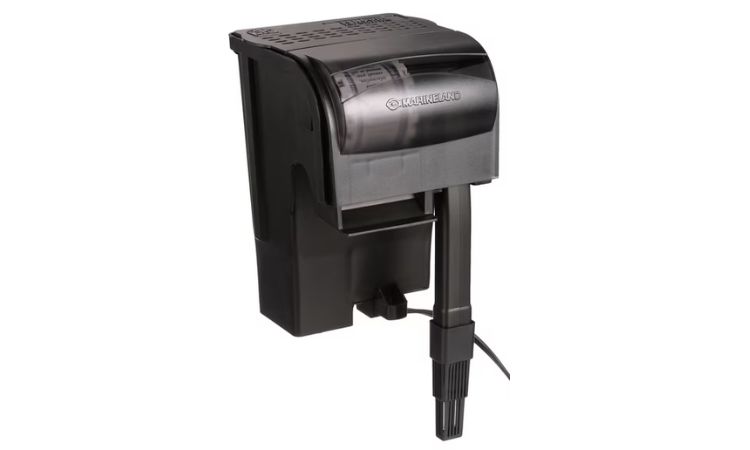
4. MarineLand Penguin Bio-Wheel Power Filter (Best Hang-on-Back Filter)
Not every large aquarium requires a canister filter. For lightly to moderately stocked aquariums up to 75 gallons, the MarineLand Penguin Bio-Wheel Power Filter remains one of the better-performing hang-on-back options.
Its rotating Bio-Wheel provides additional biological filtration while separate mechanical and chemical stages help remove debris and dissolved impurities. Installation is simple, and maintenance is generally easier than servicing a canister filter.
Like many cartridge-based HOB filters, however, experienced hobbyists often modify the media arrangement by using reusable sponge and biological media rather than replacing disposable cartridges on a fixed schedule.
Pros
- Easy installation
- Good biological filtration
- Affordable purchase price
- Suitable for freshwater and marine aquariums
- Simple routine maintenance
Cons
- Smaller media capacity than canister filters
- Cartridge system may increase long-term maintenance costs
- Less suitable for heavily stocked tanks
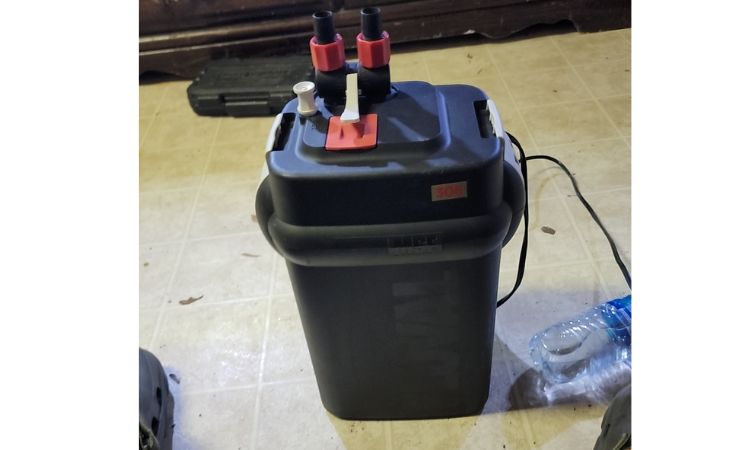
5. Fluval 306 External Canister Filter (Best for Quiet Operation)
The Fluval 306 External Filter is a solid option for aquariums between 45 and 70 gallons, combining dependable filtration with relatively quiet operation.
Its multi-stage filtration uses separate media baskets that simplify maintenance while allowing hobbyists to customize mechanical, biological, and chemical media independently. The Aquastop valve also makes cleaning easier by allowing hoses to be disconnected without draining the entire system.
Although newer Fluval 07 Series filters have replaced the 306 in many markets, this model continues to deliver dependable performance where it remains available.
Pros
- Quiet operation
- Good media capacity
- Easy maintenance
- Leak-resistant hose connections
- Reliable multi-stage filtration
Cons
- Lid can require firm alignment during reassembly
- Lower flow than larger canister filters
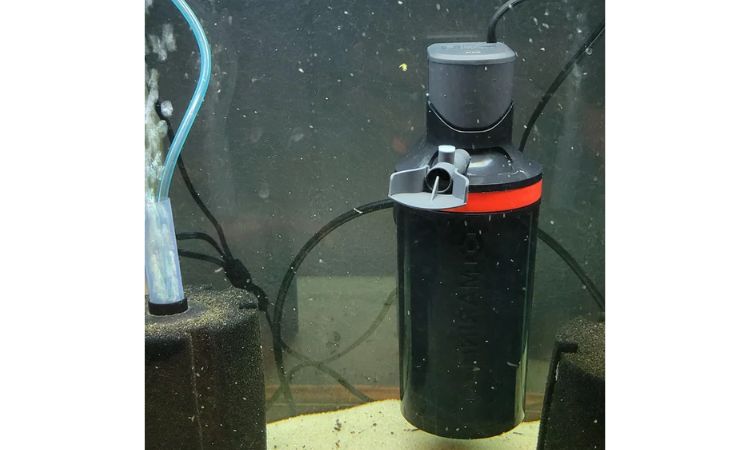
6. MarineLand Magnum Internal Canister Filter (Best Internal Filter for Large Tanks)
The MarineLand Magnum Internal Canister Filter is designed for aquariums up to 97 gallons and offers an alternative for hobbyists who prefer not to install an external canister.
Unlike most internal filters, it supports three-stage filtration and includes a polishing cartridge capable of removing very fine suspended particles, making it useful for clearing cloudy water after maintenance or aquascaping.
Its compact design eliminates external hoses, reducing the risk of leaks while simplifying installation. However, because the unit occupies space inside the aquarium, it may not be ideal for aquascapes where maximizing display area is a priority.
Pros
- Easy installation
- Effective water polishing capability
- Good mechanical filtration
- Self-priming design
- Suitable for temporary polishing or continuous filtration
Cons
- Occupies space inside the aquarium
- Louder than some external canister filters
- Water polishing and standard filtration use different media configurations
Pro Tips for Maximizing Large Tank Filtration Efficiency
Arrange Filter Media in the Correct Order
The way filter media is organized has a direct impact on filtration performance and maintenance intervals. Water should always pass through media from coarse to fine, allowing each stage to perform its intended function efficiently.
A practical arrangement is:
- Mechanical filtration first: Use coarse sponges or foam blocks to capture large debris, uneaten food, and suspended particles before they reach the biological media. Fine polishing pads or filter floss can follow if crystal-clear water is the goal, but they require more frequent cleaning or replacement.
- Biological filtration second: Fill the largest available space with high-surface-area media such as ceramic rings, sintered glass, or bio-balls. These materials provide extensive habitat for nitrifying bacteria that convert toxic ammonia into nitrite and then nitrate. Since biological filtration supports the nitrogen cycle, preserving this media is more important than keeping it visually clean.
- Chemical filtration last: Activated carbon, Purigen, or other specialized chemical media should be positioned after the mechanical and biological stages. This placement prevents debris from clogging the chemical media prematurely while allowing cleaner water to pass through it. Chemical media is optional for many established aquariums but can be valuable for removing medications, discoloration, odors, or specific dissolved compounds.
Following this sequence improves water flow, extends media life, and makes routine maintenance more efficient.
Eliminate Dead Zones with Better Water Circulation
Even a powerful canister filter cannot always create consistent circulation throughout a large aquarium. Decorations, dense plant growth, driftwood, and rock structures can produce areas with minimal water movement where detritus accumulates.
To improve circulation:
- Position the filter outlet to create movement across the full length of the aquarium.
- Aim return nozzles toward areas where debris commonly settles.
- Add a wavemaker or powerhead in tanks longer than approximately 4 feet or in heavily aquascaped layouts.
- Adjust flow patterns so debris remains suspended long enough to be captured by the filter rather than collecting behind decorations.
Better circulation also distributes oxygen more evenly, stabilizes temperature throughout the aquarium, and ensures beneficial bacteria receive a constant supply of oxygen-rich water.
Follow a Consistent Maintenance Schedule
Large aquarium filters perform best with regular maintenance rather than infrequent deep cleaning. Waiting until flow drops dramatically often reduces filtration efficiency and places unnecessary stress on the filter pump.
A practical maintenance routine includes:
- Cleaning pre-filter sponges every 2 to 4 weeks, or sooner in heavily stocked aquariums.
- Rinsing coarse mechanical media whenever accumulated debris noticeably restricts water flow.
- Cleaning biological media only when necessary, using removed aquarium water rather than untreated tap water to minimize disruption to beneficial bacterial colonies.
- Servicing different biological media trays on alternating maintenance sessions instead of cleaning everything simultaneously.
- Inspecting the impeller, impeller well, hoses, and intake strainers periodically to remove biofilm and debris that can reduce flow or increase operating noise.
Staggering maintenance helps preserve the aquarium’s biological filtration while keeping water circulation stable. Combined with appropriate stocking levels and regular water changes, a well-maintained filtration system provides clearer water, more stable water quality, and a healthier environment for fish over the long term.