Live plants do far more than enhance the appearance of an aquarium—they help create a healthier, more natural ecosystem for fish and invertebrates. Fortunately, many species are incredibly forgiving and thrive in low-tech setups, making them ideal for newcomers. Explore the best beginner freshwater aquarium plants that combine attractive growth, simple care, and dependable performance for easy aquascaping success.
1. Anubias Nana (Anubias barteri var. nana)
Lighting Requirements: Low
Growth Rate: Slow
Placement: Foreground to midground, attached to driftwood, rocks, or other hardscape
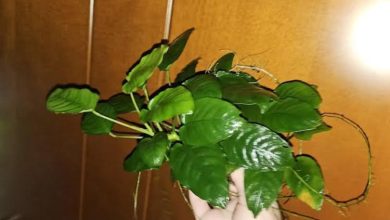
Anubias Nana is widely regarded as one of the best freshwater aquarium plants for beginners because it combines exceptional durability with minimal care requirements. Its compact size and broad, dark green leaves make it suitable for nano tanks as well as larger community aquariums, where it adds natural texture without overwhelming the layout.
Unlike rooted aquarium plants, Anubias Nana is an epiphyte that grows from a thick horizontal rhizome. The rhizome should always remain above the substrate, as burying it can restrict water circulation and eventually cause rot. Instead, secure the plant to driftwood or rocks using aquarium-safe gel glue, cotton thread, or fishing line until its roots naturally attach to the surface.
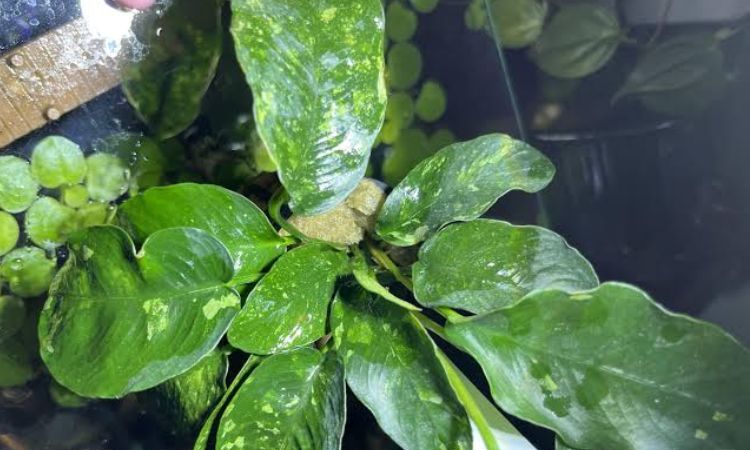
This species thrives under low lighting and does not require supplemental CO₂, making it an excellent choice for low-tech planted tanks. Although growth is relatively slow, that also means less pruning and reduced maintenance over time. Occasional liquid fertilizer can support healthier foliage, but established aquariums often provide sufficient nutrients for steady growth.
Another advantage is its thick, leathery leaves, which are less appealing to many herbivorous fish than softer aquatic plants. While no plant is completely fish-proof, Anubias Nana generally holds up well in aquariums with species that occasionally nibble vegetation.
Why it’s an excellent beginner plant:
- Tolerates low-light aquariums with ease
- Grows without CO₂ injection
- Requires very little pruning
- Easily attaches to wood and stone for natural aquascapes
- More resistant to browsing by many plant-eating fish than delicate species
2. Java Fern (Microsorum pteropus)
Lighting Requirements: Low to Medium
Growth Rate: Slow
Placement: Midground to background, attached to driftwood or rocks
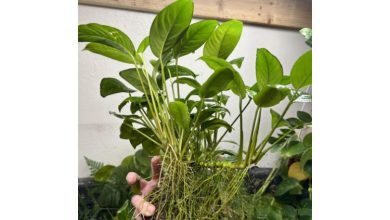
Java Fern has remained a favorite among aquarium hobbyists for decades because it adapts to an exceptionally wide range of freshwater conditions. Whether housed in a beginner community tank or a mature planted aquarium, it typically establishes with very little intervention.
Like Anubias, Java Fern is an epiphytic plant and should never have its rhizome buried beneath gravel or sand. Instead, attach it to driftwood, rocks, or decorative hardscape, allowing the roots to gradually anchor themselves over time. This flexibility makes it especially useful for creating natural-looking aquascapes with layered wood and stone.
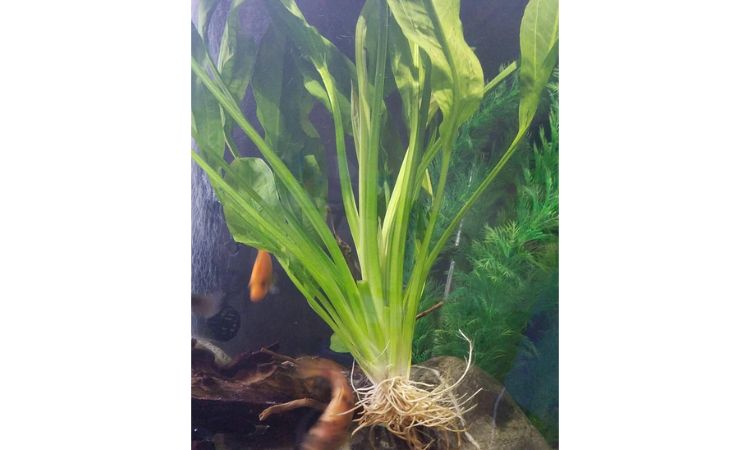
Its long, arching leaves introduce height and movement while remaining relatively undemanding. Java Fern grows well under low to moderate lighting and generally requires neither pressurized CO₂ nor specialized substrates. Periodic liquid fertilization may encourage stronger growth, but many aquarists successfully grow it using only nutrients available in the aquarium water.
One of the species’ most interesting characteristics is its natural method of propagation. Mature leaves often develop tiny plantlets along their edges or undersides. Once these young ferns produce roots and several leaves, they can be separated and attached elsewhere in the aquarium, allowing hobbyists to expand their planting without purchasing additional specimens.
Why it’s an excellent beginner plant:
- Adapts to a wide range of water parameters
- Performs well in low-tech aquariums
- Requires no nutrient-rich substrate
- Naturally propagates by producing baby plantlets
- Adds height and texture with minimal maintenance
3. Amazon Sword (Echinodorus grisebachii)
Lighting Requirements: Medium
Growth Rate: Medium to Fast
Placement: Background
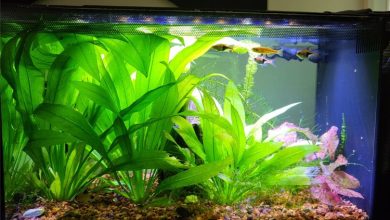
Amazon Sword is one of the classic background plants in freshwater aquariums, valued for its broad leaves and impressive size. As it matures, it forms a dense cluster of foliage that creates a natural backdrop while providing shelter for community fish, shrimp, and other aquatic inhabitants.
Unlike epiphytic plants, Amazon Sword is a heavy root feeder. Although it can grow in ordinary gravel or sand, it performs significantly better when root tabs are placed beneath the plant to provide essential nutrients. A nutrient-rich substrate can also support vigorous growth, but it is not strictly necessary for beginners using a simple aquarium setup.
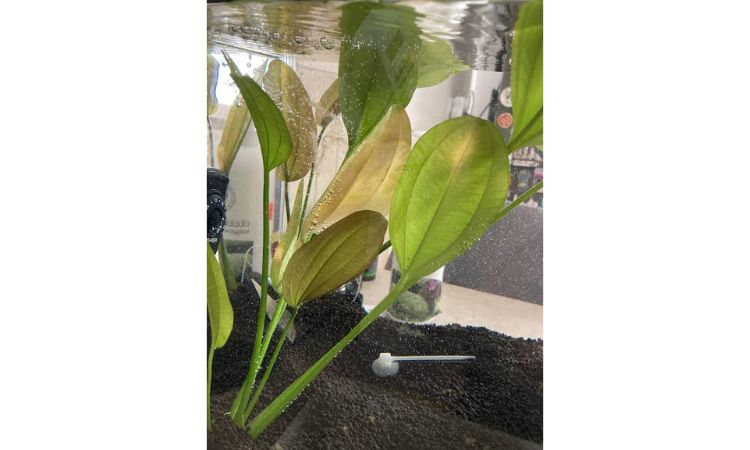
Newly purchased specimens often shed their original leaves after being introduced to a submerged environment. This transition is normal because many commercially grown Amazon Swords are cultivated above water before sale. As the plant adapts, it replaces those leaves with narrower submerged foliage that is better suited to life underwater.
With adequate nutrition and stable conditions, Amazon Sword grows steadily into an attractive centerpiece that fills empty background space without requiring advanced equipment. Mature plants may also produce flowering stalks that develop small daughter plants, which can be separated and replanted to create additional specimens.
Why it’s an excellent beginner plant:
- Creates a lush, natural background with large green leaves
- Adapts well to standard freshwater aquariums
- Thrives in simple gravel or sand when supplemented with root tabs
- Helps create shelter and visual depth in planted layouts
- Propagates naturally by producing new plantlets on mature flower stalks
4. Cryptocoryne Wendtii (Cryptocoryne wendtii)
Lighting Requirements: Low to Medium
Growth Rate: Slow to Medium
Placement: Foreground to Midground
Cryptocoryne wendtii is one of the most dependable aquarium plants for beginners, offering an attractive combination of hardiness, color variation, and simple care. Available in green, bronze, brown, and reddish forms, it adds visual depth and subtle contrast to planted aquariums without requiring demanding maintenance or specialized equipment.
This rosette plant grows best when its roots are anchored in the substrate, making it well suited for the foreground or midground of community tanks. While it adapts to a variety of substrates, it benefits from nutrient-rich aquarium soil or occasional root tabs when grown in gravel or sand. Once established, it develops dense clusters of leaves that create a natural transition between shorter foreground plants and taller background species.
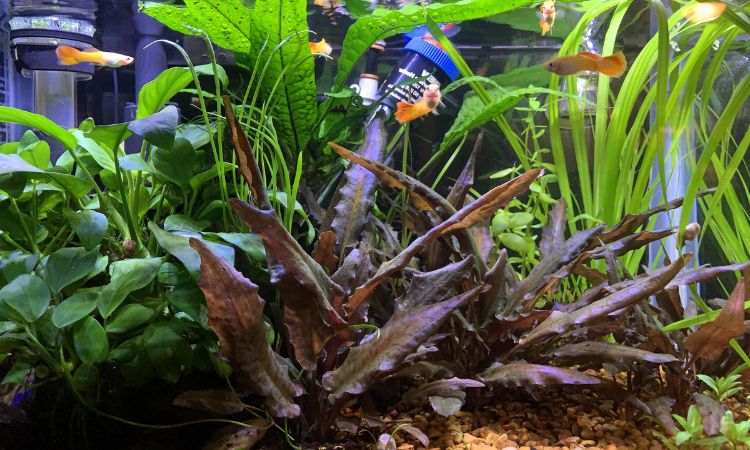
One characteristic every beginner should understand is “crypt melt.” After being introduced to a new aquarium, the plant may lose some or even all of its leaves as it adjusts to different water chemistry, lighting, or temperature. Although this can appear alarming, it is a normal adaptation process rather than a sign that the plant has died. As long as the root system remains healthy and water conditions are stable, new submerged leaves typically emerge within several weeks.
Cryptocoryne wendtii performs well under low to moderate lighting and generally does not require supplemental CO₂. Its adaptability and steady growth make it an excellent choice for low-tech aquascapes designed around ease of maintenance.
Why it’s an excellent beginner plant:
- Adapts well to stable freshwater aquariums
- Available in multiple leaf colors for added visual interest
- Thrives in low- to moderate-light setups
- Requires only occasional root fertilization in nutrient-poor substrates
- Develops attractive, compact clumps with minimal pruning
5. Marimo Moss Balls (Aegagropila linnaei)
Lighting Requirements: Low
Growth Rate: Extremely Slow
Placement: Foreground
Marimo moss balls are among the easiest aquatic additions for beginner aquariums, despite not being true mosses or even true plants. They are naturally occurring spherical colonies of green algae that develop into soft, velvety balls over many years, making them a distinctive feature in freshwater aquascapes.
Because they require no planting, Marimo moss balls can simply be placed on the substrate, where they create an attractive foreground accent in nano aquariums, shrimp tanks, and betta habitats. Their unique shape provides a welcome contrast to traditional stem and rosette plants while contributing to a more natural-looking layout.
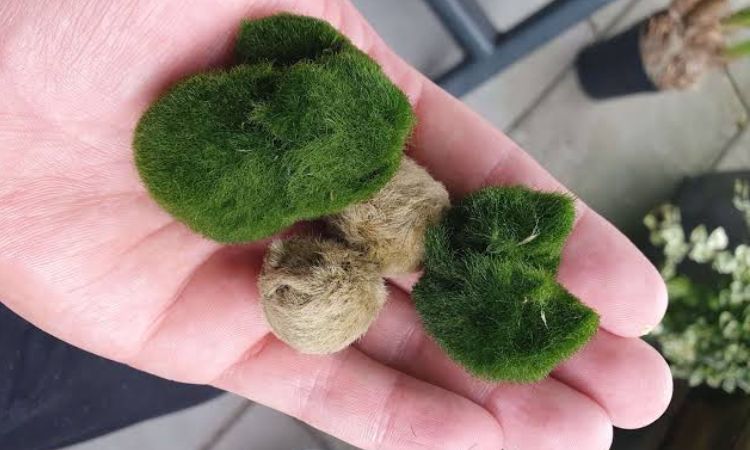
These algae colonies perform best under low lighting and require very little routine care. During regular water changes, gently rolling each ball helps maintain its rounded form while ensuring all sides receive light exposure. Aside from occasional cleaning to remove trapped debris, they need little attention.
Although Marimo moss balls grow extremely slowly, they absorb small amounts of dissolved nutrients from the water and provide additional surface area for beneficial microorganisms to colonize. Shrimp often graze on these biofilms, making Marimo moss balls a practical addition to freshwater shrimp aquariums.
Why it’s an excellent beginner plant:
- Requires virtually no specialized care
- Thrives under low-light conditions
- Needs no substrate, fertilizers, or CO₂ injection
- Adds unique texture and visual interest to aquascapes
- Suitable for nano tanks, shrimp aquariums, and betta setups
- Simple maintenance consists of occasional rinsing and gently rolling the ball during water changes