Some aquatic plants demand constant attention, but Anubias Nana rewards patience instead of intensive care. Growing slowly from a creeping rhizome, this hardy freshwater plant produces thick, deep green leaves that remain attractive throughout the year. Because it tolerates a wide range of water conditions and doesn’t rely on injected CO₂, it’s an excellent addition to everything from shrimp tanks to large community aquariums.
Keep reading to discover how to plant Anubias Nana correctly, prevent common mistakes, propagate healthy specimens, and encourage steady, long-lasting growth.
What is Anubias Nana? (Overview & Characteristics)
Anubias Nana (Anubias barteri var. nana) is one of the most popular freshwater aquarium plants in the world—and for good reason. It’s incredibly hardy, easy to care for, and adaptable to a wide range of aquarium conditions. Whether you’re setting up your very first planted tank or designing a detailed aquascape, this compact species offers long-lasting beauty without requiring advanced equipment or constant maintenance.

Unlike fast-growing stem plants that demand frequent trimming, Anubias Nana grows at a relaxed pace. Its sturdy leaves remain attractive for months, making it an excellent choice for aquariums where stability and low maintenance are priorities. Because it naturally attaches to rocks and driftwood rather than relying on substrate, it’s also one of the most versatile plants for creative aquascaping.
The plant is commonly used in community aquariums, shrimp tanks, nano aquariums, and even many cichlid setups, where its thick leaves are less likely to be damaged by curious or plant-nibbling fish.
Origin & Natural Habitat
Anubias Nana is native to West Africa, with wild populations primarily documented in Cameroon. In nature, it grows along shaded riverbanks, slow-moving streams, and seasonally flooded forests, where humidity remains high and water conditions are relatively stable throughout the year.
Instead of rooting deeply in mud, the plant typically anchors itself to rocks, submerged tree roots, and fallen branches. During the rainy season, it may spend months completely underwater, while in drier periods portions of the plant can remain exposed to humid air. This natural adaptability explains why Anubias Nana performs equally well in fully submerged aquariums, paludariums, and ripariums.
The shaded environments of its native habitat also help explain why the plant thrives under low to moderate lighting rather than requiring intense illumination.
Physical Anatomy
Understanding the structure of Anubias Nana makes proper care much easier. Unlike many aquarium plants, each part serves a specific function that directly affects how it should be planted and maintained.
Rhizome
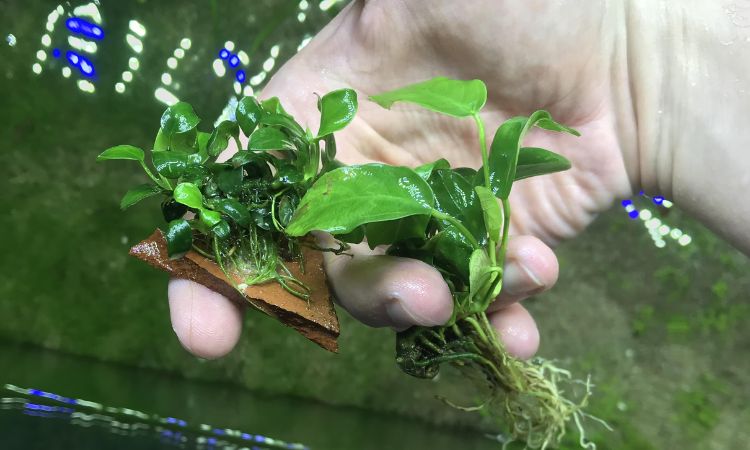
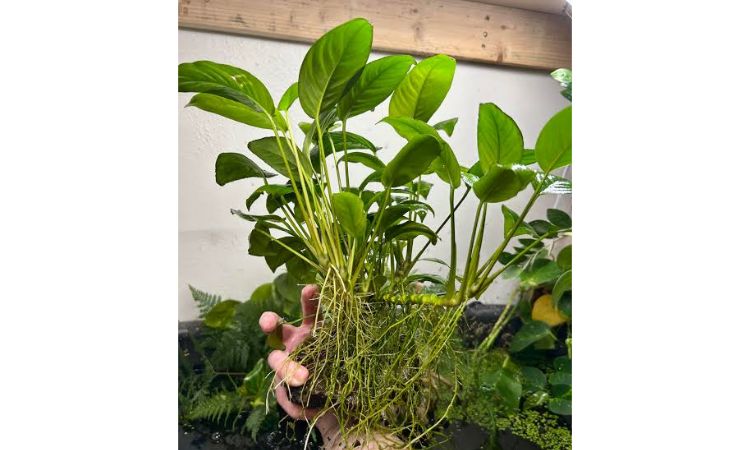
The rhizome is the thick, horizontal stem running along the base of the plant and is the most important feature to recognize. New leaves emerge from the upper side of the rhizome, while roots develop from the underside as it slowly spreads across hard surfaces.
Because the rhizome stores nutrients and transports water throughout the plant, it must remain exposed to circulating water. Burying it beneath aquarium substrate restricts oxygen flow and often causes it to rot, which is one of the most common reasons Anubias Nana fails in otherwise healthy aquariums.
Instead of planting it like a typical rooted species, attach the rhizome to driftwood, natural stone, or aquarium décor, allowing it to establish itself naturally over time.
Leaves
Anubias Nana produces broad, oval-shaped leaves with a thick, leathery texture that distinguishes it from many softer aquatic plants. Mature foliage is typically a rich, dark green, although newly emerging leaves appear lighter before gradually deepening in color.
The durable leaf structure helps the plant withstand moderate water flow, grazing by shrimp and snails, and occasional attention from fish that might damage more delicate vegetation. Since each leaf remains healthy for an extended period, the plant maintains an attractive appearance even though it produces new growth relatively slowly.
Roots
Strong white roots emerge from the underside of the rhizome and serve two important purposes. First, they anchor the plant securely to driftwood, rocks, and other hardscape materials. Over time, these roots naturally grip rough surfaces without requiring permanent ties or glue.
Second, the roots absorb nutrients from the surrounding water and any nearby organic matter. While they may extend into gravel or aquarium soil after attachment, they do not need to be buried to keep the plant healthy.
Growth Expectations
Anubias Nana is considered a slow-growing aquatic plant, which is one of the reasons it remains so easy to maintain. Under typical aquarium conditions, it often produces one new leaf every three to four weeks, although growth can vary depending on lighting, nutrient availability, temperature, and overall water quality.
This gradual growth means the plant rarely requires pruning, making it ideal for hobbyists who prefer low-maintenance aquariums. It also helps aquascapes retain their intended design for longer periods without constant trimming or replanting.
While injected CO₂ and balanced fertilization can modestly increase growth speed, patience is still part of growing Anubias Nana successfully. Rather than expanding rapidly, the plant invests its energy in producing thick, long-lasting leaves that can remain attractive for many months, providing consistent greenery and structure in a planted aquarium.
Ideal Tank Setup & Water Parameters
One of the biggest reasons Anubias Nana has become a staple in the aquarium hobby is its adaptability. Unlike many aquatic plants that require specialized equipment or carefully balanced conditions, Anubias Nana grows well in a wide range of freshwater aquariums. As long as the water remains clean and stable, it can thrive for years with very little intervention.
Creating the right environment isn’t about chasing perfect numbers—it’s about providing consistent conditions that support slow, healthy growth while minimizing algae and other common problems.
Tank Size Requirements
Anubias Nana is suitable for aquariums of almost any size. Its compact growth habit makes it an excellent choice for nano tanks as small as 5 gallons (19 liters), yet it’s equally effective in larger community aquariums exceeding 100 gallons.
In small aquariums, a single specimen can become an attractive focal point when attached to a small piece of driftwood or stone. In medium and large tanks, multiple plants can be grouped together to soften hardscape, frame pathways, or create natural-looking transition areas between the foreground and midground.
Because the plant grows slowly and stays relatively compact, it rarely overwhelms the aquascape or requires frequent repositioning.
Recommended Water Parameters
Anubias Nana naturally inhabits tropical freshwater streams where environmental conditions remain relatively stable throughout the year. Fortunately, it adapts well to a broad range of water chemistry found in home aquariums.
The following parameters provide ideal growing conditions:
| Parameter | Recommended Range |
| Temperature | 72–82°F (22–28°C) |
| pH | 6.0–7.8 |
| General Hardness (GH) | 3–12 dGH |
| Carbonate Hardness (KH) | 2–10 dKH |
| Ammonia | 0 ppm |
| Nitrite | 0 ppm |
| Nitrate | Below 20 ppm for optimal health (higher levels are usually tolerated if stable) |
While Anubias Nana can survive outside these ranges, sudden swings in temperature or water chemistry often cause more stress than slightly imperfect values. Maintaining consistent conditions is far more important than trying to achieve exact numbers.
Regular partial water changes, adequate filtration, and avoiding rapid parameter shifts will help keep the plant healthy over the long term.
Substrate Considerations
Unlike Amazon swords, Cryptocoryne species, and other heavy root-feeding plants, Anubias Nana does not rely on substrate for most of its nutrition. Instead, it absorbs the majority of nutrients directly from the water column through its leaves and rhizome.
Because of this, the choice of substrate is largely a matter of aesthetics and the needs of other plants in the aquarium.
Suitable options include:
- Fine aquarium sand
- Natural gravel
- Aquarium soil or nutrient-rich substrates
- Inert decorative substrates
The most important consideration is not the substrate itself, but ensuring the rhizome remains above it. Only the roots may extend into the substrate if desired. Burying the rhizome restricts oxygen exchange and significantly increases the risk of rot.
If the aquarium contains only Anubias and other epiphytic plants such as Java Fern or Bucephalandra, an expensive nutrient-rich substrate is generally unnecessary.
Flow & Filtration
Anubias Nana performs best in gentle to moderate water movement. Moderate circulation keeps oxygen and nutrients moving around the leaves while preventing waste, detritus, and uneaten food from accumulating on the plant’s broad foliage.
In aquariums with very little circulation, debris can settle on the leaves, reducing their appearance and encouraging algae growth. On the other hand, excessively strong currents are unnecessary and may cause larger leaves to sway constantly, although the plant itself usually tolerates moderate flow without difficulty.
Positioning Anubias near the gentle outflow of a filter often provides an ideal balance of circulation without exposing it to excessive turbulence.
A quality biological filtration system, combined with routine maintenance and regular water changes, will create a stable environment where Anubias Nana can thrive for many years.
Aquascaping Tips for Placement
Since Anubias Nana naturally grows attached to hard surfaces, think beyond simply placing it in the substrate. It looks especially attractive when secured to driftwood branches, nestled between rocks, or positioned in shaded areas beneath taller plants.
Many aquascapers use it to:
- Cover exposed driftwood with lush green foliage.
- Soften the edges of large rocks and stone formations.
- Fill empty spaces between hardscape elements.
- Create natural-looking midground focal points.
- Add texture to shrimp tanks and nano aquascapes.
Because the plant stays compact and grows slowly, it helps maintain the original layout for months without frequent trimming or rearranging, making it one of the easiest species to incorporate into a long-lasting aquascape.
How to Plant Anubias Nana (Step-by-Step)
Method 1: Attach Anubias Nana to Driftwood or Rocks (Recommended)
Mounting Anubias Nana to hardscape is the most natural and reliable planting method. In the wild, the plant grows attached to submerged wood, tree roots, and rocks rather than rooted in sediment. This approach also highlights its growth habit and reduces the risk of rhizome rot.
Option A: Using Cotton Thread or Fishing Line
This traditional method works well if you want a temporary attachment that allows the roots to secure themselves naturally.
Steps:
- Choose a clean piece of driftwood or aquarium-safe rock with a rough surface.
- Position the rhizome so it rests flat against the hardscape.
- Wrap cotton thread or clear fishing line gently around the rhizome several times.
- Tie it securely without squeezing the rhizome too tightly.
- Place the hardscape in the aquarium.
Within a few weeks, the roots will grip the surface. Cotton thread gradually decomposes underwater, while fishing line can be removed once the plant is firmly attached.
Option B: Using Aquarium-Safe Super Glue Gel
Cyanoacrylate gel is one of the quickest and most popular ways to secure Anubias Nana.
Don’t worry—the glue is safe for aquariums once cured.
Steps:
- Dry the area of the rock or driftwood where the plant will be attached.
- Apply a small drop of aquarium-safe cyanoacrylate gel to the hardscape.
- Press the rhizome gently into the adhesive for 20 to 30 seconds.
- Allow the glue to set before placing everything back into the aquarium.
Only a tiny amount of glue is needed. Avoid coating the roots or covering large sections of the rhizome, as this may interfere with natural growth.
Why This Method Is Best
Attaching Anubias Nana to hardscape offers several advantages:
- Eliminates the risk of burying the rhizome.
- Creates a natural appearance similar to its wild habitat.
- Allows roots to spread freely over wood or stone.
- Makes rearranging the aquascape much easier.
- Works in tanks with sand, gravel, or no substrate at all.
Method 2: Planting Anubias Nana in the Substrate
Although attaching the plant to hardscape is generally preferred, Anubias Nana can also be positioned near the substrate when done correctly.
The key is to plant only the roots—not the rhizome.
Step-by-Step
- Dig a shallow hole just deep enough for the roots.
- Carefully guide the fine white roots into the opening.
- Cover only the roots with sand, gravel, or aquarium soil.
- Leave the entire rhizome sitting above the substrate where it remains visible.
The finished plant should appear as though it is resting on top of the substrate, with only the roots hidden below.
This method works especially well when you want the plant to blend naturally into foreground or midground layouts without attaching it to a rock.
Common Mistake to Avoid
Many hobbyists accidentally cover the rhizome while adding substrate around the roots. Even if only part of the rhizome is buried, prolonged contact with substrate can eventually cause decay.
If you notice the rhizome disappearing beneath gravel after maintenance or fish activity, gently uncover it as soon as possible.
Method 3: Natural Placement Without Glue
Not every aquascape requires thread or adhesive. Because Anubias Nana naturally develops strong anchoring roots, it can often secure itself without any assistance.
Simply place the rhizome into a narrow gap between rocks, driftwood branches, or other hardscape where it fits snugly.
The plant’s roots will gradually grow into the crevice and attach themselves over the following weeks.
This technique works particularly well for:
- Nature-style aquascapes.
- Rock gardens.
- Driftwood branch intersections.
- Crevices in dragon stone or lava rock.
- Areas where glue would be difficult to apply.
If the plant shifts during water changes or strong filter flow before the roots establish themselves, simply reposition it until it anchors naturally.
How to Propagate Anubias Nana
Propagating Anubias Nana is a simple process that involves dividing the plant’s rhizome rather than taking stem cuttings. As the rhizome gradually grows longer, it produces new leaves and roots along its length. Once the plant is mature enough, it can be separated into multiple healthy plants that will continue growing independently.
Wait Until the Plant Is Mature
Before dividing Anubias Nana, allow it to develop a well-established rhizome. A healthy candidate for propagation should have:
- A rhizome at least 3 inches (7–8 cm) long.
- 6–8 healthy leaves or more.
- A strong root system with several white, healthy roots.
Dividing a small or recently established plant can slow its growth and reduce the chances of successful recovery.
Step 1: Prepare the Plant
You can propagate the plant either by removing it from the aquarium or by working carefully inside the tank if it is firmly attached to a large piece of driftwood or rock.
Inspect the rhizome and remove any damaged or decaying leaves before making the cut.
Step 2: Sterilize Your Cutting Tool
Use a sharp pair of aquascaping scissors, a razor blade, or a hobby knife that has been cleaned and sterilized. A sharp blade creates a smooth cut that heals more quickly and reduces the risk of infection or rot.
Step 3: Divide the Rhizome
Locate a section where both new plants will retain enough healthy tissue.
Cut the rhizome cleanly into two sections, making sure each division contains:
- At least 3–4 healthy leaves
- Several healthy roots
- A portion of the rhizome
Avoid creating very small divisions, as larger sections establish themselves much more quickly.
Step 4: Attach the New Plants
Secure each newly divided rhizome to driftwood, rocks, or other aquarium hardscape using aquarium-safe cyanoacrylate gel, cotton thread, or fishing line.
Keep the rhizome completely exposed above the substrate while allowing the roots to anchor naturally over the following weeks.
Caring for Newly Propagated Plants
Freshly divided Anubias Nana usually adapts quickly when water conditions remain stable.
For the best results:
- Provide low to moderate lighting.
- Maintain consistent water quality and temperature.
- Continue routine liquid fertilization if used.
- Avoid moving the plant until the roots firmly attach to the hardscape.
It’s normal for growth to slow briefly after propagation. Once the plant has re-established its root system, it will gradually resume producing new leaves.